

“Man is a god when he dreams, a beggar when he reflects” — Hölderlin
I came across an excerpt from Werner Herzog’s book the other day (from Brad Skow‘s note) where he complains about introspection and considers it one of the mistakes that made the past century terrible:
But I have a deep aversion to too much introspection, to navel-gazing.
I’d rather die than go to an analyst, because it’s my view that something fundamentally wrong happens there. If you harshly light every last corner of a house, the house will be uninhabitable. It’s like that with your soul; if you light it up, shadows and darkness and all, people will become “uninhabitable.” I am convinced that it’s psychoanalysis-along with quite a few other mistakes-that has made the twentieth century so terrible. As far as I’m concerned, the twentieth century, in its entirety, was a mistake.
In my corner of the internet, Marc Andreessen’s recent podcast appearance was going around and people were mocking him because he said he didn’t believe in introspection. He’s onto something there. He is directionally right. I recently read a Substack note from Marlene Jo that resonated: “[…] one becomes clearer to oneself when looking out and away, rather than in […]”.
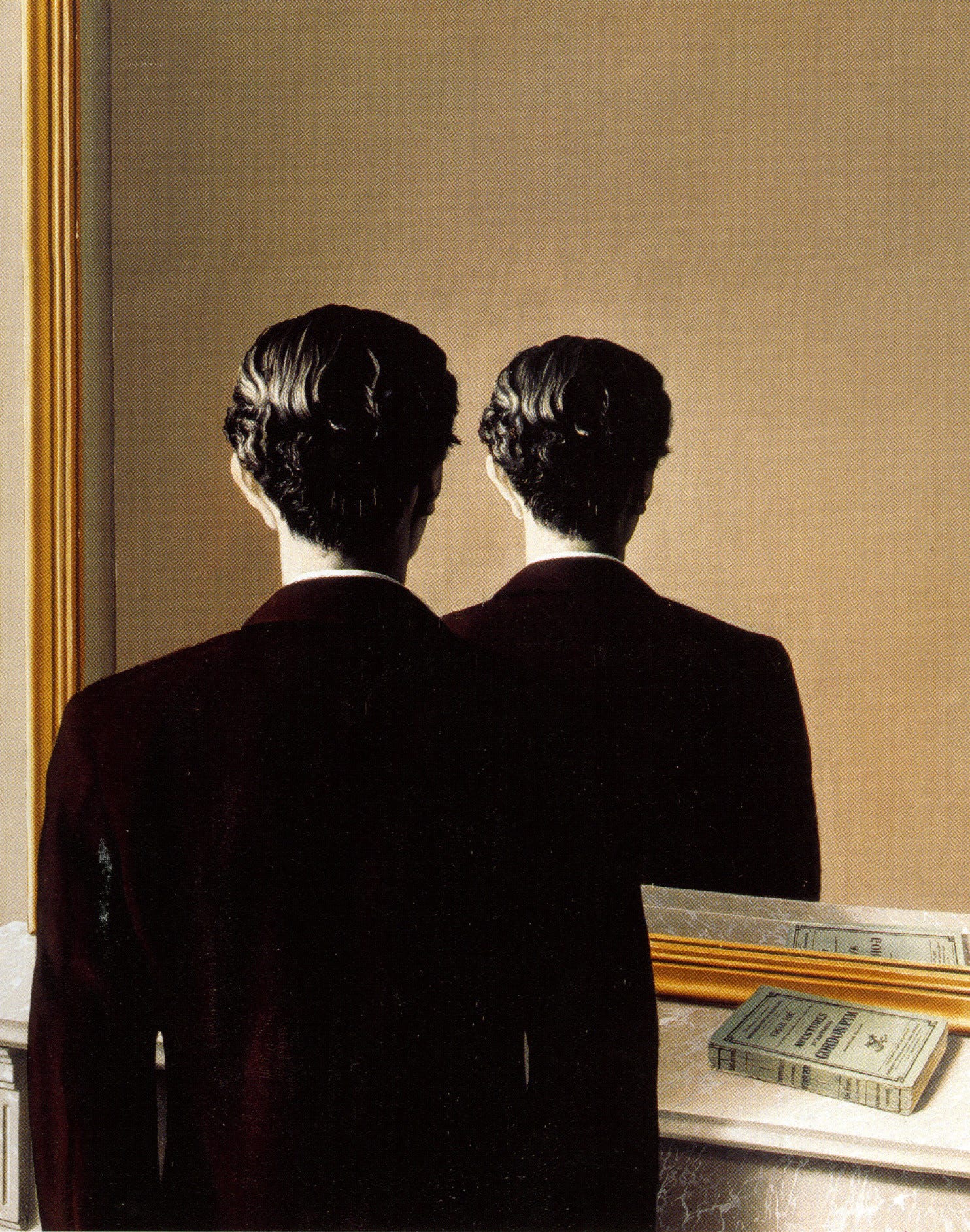
As someone who spent an unhealthy amount of time over the past couple of years introspecting in this or that way, both publicly and privately, I couldn’t agree more. It’s easy to fall for the trap of introspection because of the implicit promise: you’ll understand yourself better if you do it. Knowing yourself, or the prescription of “Gnothi Seauton” from ancient Greece, is a worthy goal to have. The most popular means of getting there is not particularly right. I no longer think you build yourself in your journals or diaries. We build better understanding of ourselves by searching for the glimpses of ourselves in other people’s perceptions. We see ourselves best through other people. Through their models of us. As if they are holding pieces of the puzzle of our own person, except the pieces are little mirrors.
The introspection doesn’t illuminate, it hollows us out. The Last Psychiatrist diagnosed it correctly when he said that ours is the age of narcissism. It’s easy to dismiss such claims and think that everyone is labeled as a narcissist these days. But these claims are often correct. And this introspection is a good way for making it worse. It also pairs well with the common Stoic advice that other people are not your responsibility. Or the one that you should always put yourself first. The age of narcissism is the age in which self is god. And although the inner world is, like the outer world, endless, this god is still too small. This philosophy makes god small and ourselves big, which is not healthy at all.
I’m sick of all the navel-gazing I’ve been a victim of these past years and I want to focus on the outer world more. Ironically, this practice teaches me more about myself than a combination of introspection and rumination ever could. It teaches me about my interests and what excites me about the world.
My latest obsession has been the creative processes of my literary influences. I’m building “a bicycle for the mind” (in the words of Steve Jobs) — a note taking app that fits my own creative process the best, which is why I’m reading books about Emerson and his own journals and writing. How he assembled his own essays by arranging the sentences from his journals and then testing the reception of them by giving a public speech first and only after that published the essay. These sentences don’t follow the single point necessarily and they meander, which is why reading his essays sometimes feels like you’re getting hit by ocean waves of prose, slowly washing over you with their intricate lyricism. It is no surprise that one of his biggest influences, Montaigne, is described like this by Phillip Lopate in To Show And to Tell:
Montaigne’s essays, as we know, grew longer and longer, until the majestic final essays in Book III. Faced with these happily uncompromising streams of association, the reader feels as though on an open boat launched onto the ocean, with no horizon line in sight. You just have to surrender to the waves of sentences that keep bumping you from one idea to another.
But it would be a mistake to consider Montaigne an introspector. Sure, he starts from himself, but he doesn’t linger. His gaze is always pointing outwards because he knows he himself is not that interesting. The specificity of himself is only a door to the general, to the universal. This is the correct posture to have. Ground your writing in yourself, in your own experience, but don’t linger on it — reach for the outer.
Ernest Dimnet writes:
If we will indulge in a little introspection we shall find that our mind is peopled with more incipient obsessions than ideas, and that their presence is largely the cause of our impotency.
The line between introspection and excessive rumination is very thin and one can easily fall into that trap. It’s not that difficult to be deluded by it and to think that we are discovering great ideas and insights. But the danger is that we enter the hall of mirrors and find out that the exit is hard to find. In the end we find no one there.
To play devil’s advocate, is this piece itself not teetering on introspection? Can it even be avoided in this genre of writing?
(This is coming from a fellow over-ruminator)
“Ground your writing in yourself, in your own experience, but don’t linger on it — reach for the outer.”
— I’m going to be thinking about that line for a while.
A really interesting take, Hrvoje. :)